Kipnuk residents face uncertain return after storm repairs stall
One year after Typhoon Halong displaced over 1,000 people, hundreds in the remote Alaska village remain scattered as funding limits reconstruction options.
By Emma Foster ·
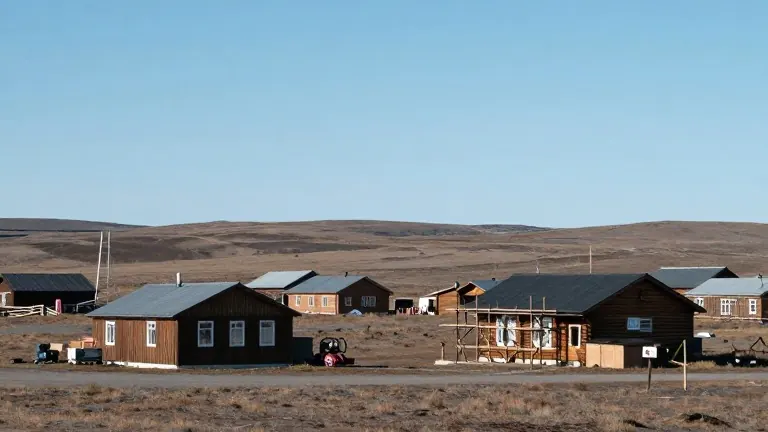
More than a year after the remnants of Typhoon Halong struck Western Alaska, residents of Kipnuk still do not know when they will return to their homes. The storm destroyed infrastructure in numerous off-road Alaska Native villages, displacing more than 1,000 people. While repairs continue, hundreds remain scattered across the state.
Kipnuk is a village of fewer than 200 homes located on the tundra, accessible primarily by plane. According to the State of Alaska Emergency Operations Center, 90 percent of the village’s residences were damaged by the storm last fall. Dozens of houses were swept off their foundations, with some families inside at the time.
Construction crews have worked on repairs throughout the past year. In August, Eddie Chuckwuk’s crew used air compressors to raise buildings back onto their foundations. Chuckwuk, a longtime resident, described the pace of work in an interview. “We’re working as fast as possible as we can to get the people back in town,” Chuckwuk said. “That’s what I just want to see, for everybody to come back and enjoy where they grew up instead of being placed in a different place … where they’re not used to. It’s pretty hard.”
State officials estimate that Federal Emergency Management Agency funds will make most homes livable by Thanksgiving. This work involves replacing wet insulation and repairing windows, doors, and roofs. However, the funding is not enough to fully restore severely damaged homes. The state is currently seeking additional money to build replacement housing.
Most residents in Kipnuk did not have home or flood insurance. The village school has no set date for reopening. Leona Paul, who works as a cook for the construction teams, noted that some residents are hesitant to return due to the trauma of the storm. “I think it’s too overwhelming for them,” Paul said, “especially the older people.”
Climate change has increased the vulnerability of coastal towns like Kipnuk to future storms. Many residents want to move the village to a safer location, but current FEMA funds are restricted to repairing existing damage. The village has not yet secured funding to relocate.
Displacement has disrupted daily life for many families. Residents living in larger towns or cities like Anchorage report challenges with adjusting to new environments. The use of the Yugtun language has decreased among some families, and children are less free to play without watching for traffic. Paul said she prefers life in Kipnuk. “You’re free to do anything you want,” she said. “In a city you just can’t do whatever you want.”
Being away from home has also separated residents from traditional hunting and gathering practices. Burt Paul’s family traveled back to Kipnuk for the summer to maintain these cultural traditions. They collected salmonberries, known as naunraqs in coastal Yugtun, from a bluff upriver from the village. Paul, who stayed behind in Kipnuk during the aftermath of the storm, said he was unsure when he would see native plants growing again. “It beats my mind that I see food growing, grass growing, fish coming in,” he said.
Paul’s family usually spends days camping and picking berries, but their trips this summer were shorter due to the need for everyone to be in town for repairs. Paul said these gatherings remain important for the community. “We have to keep things going some way, somehow, no matter what situation we go through,” he said. He remains unsure when his family and the rest of the village will be back together.
Source: WBHM · original report published
More News · Birmingham news · Report a business · Got a Story?