80 residents join Kent Island effort to restore oyster reefs
John Consoli has organized a peer network to help filter water in the Chesapeake Bay, supported by new robotic technology from the University of Maryland.
By Alejandro Ruiz ·
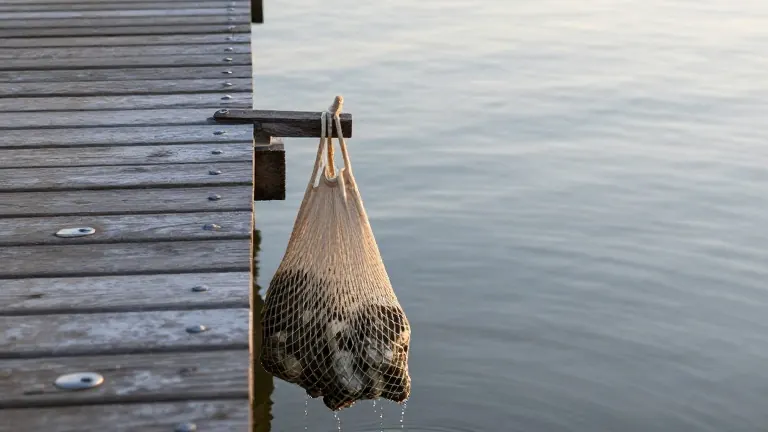
John Consoli, a professional photographer at the University of Maryland, has organized a network of approximately 80 residents on Kent Island to stock the Chesapeake Bay with oysters. The group, which Consoli calls the Peer to Pier Network, places oyster beds in private docks and public areas to improve water quality and support local marine life. Consoli stands on his pier at the southern tip of Kent Island, where he recently pulled a mesh bag of oysters from the water. He notes that the oysters weighed almost nothing when he placed them three months ago but are now full of growth.
The initiative addresses a severe decline in oyster populations. Estimates indicate that oyster reefs in the Chesapeake Bay dropped by more than 99 percent by 2011 due to overharvesting. This loss degraded water quality and reduced habitat for other species. While wild oyster numbers have partially recovered, Elizabeth North, a fisheries oceanographer at the University of Maryland Center for Environmental Science, states that current populations remain a fraction of historic levels. Each adult oyster filters up to 50 gallons of water daily, clearing the bay and promoting the growth of sea grass.
New technology from the university aims to make restoration more efficient. Miao Yu, a mechanical engineer at the University of Maryland, leads a team developing underwater robots to help farmers locate planting sites and harvest times. The team uses a custom-built robot called Oysterbot to scan the seabed with sonar. They also deploy a smaller robot, the BlueROV, to capture live video of specific areas. The lab uses artificial intelligence to analyze the data, determining oyster presence, health, and size. Yu hopes to provide farmers with precise maps to reduce guesswork and damage to the bay floor.
Consoli first became involved in oyster conservation after photographing research at the university. He now coordinates with neighbors to maintain these oyster beds. Earl Collins, an octogenarian neighbor on Kent Island, says he is impressed by the bay cleaning capabilities of the oysters. Ann Ziegler, who lives nearby, reports that her family harvested oysters from her dock for a meal. John Patrick, another participant, says he has seen croaker, crabs, and eels around his pier since installing oysters.
The network also collaborates with local businesses. In August, Consoli and eight volunteers in wetsuits placed one million baby oysters around the dock pilings of Libbey’s Coastal Kitchen. Andrew Westlin, the restaurant operator, described the project as a way for the business to give back to the community. A sign explaining the project is planned for the pier. Consoli’s wife, Kathy, notes that the effort has grown to include up to 80 people, a group she refers to as the Pied Piper of oysters.
Yu’s team has conducted field work along the coastlines of Washington state and the Gulf. She aims to scale the technology to coastlines nationwide within a decade. Consoli continues to recruit new participants, asking residents about their family connections to oysters to encourage them to grow them on their own property.
Source: WBHM · original report published
More News · Birmingham news · Report a business · Got a Story?